Clouds With Actual Shapes
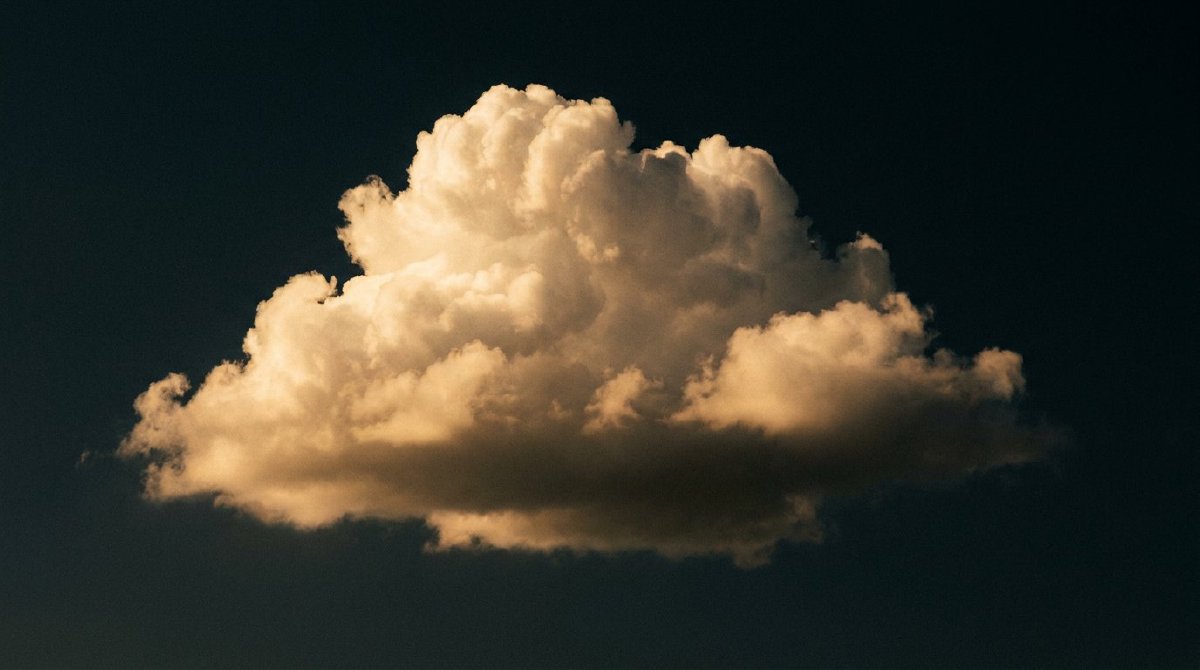
The volumetric cloud system now traces, accumulates and composites real cumulus into your scene: billowing shapes with shadowed bases and gaps of sky, masked behind your geometry, driven by the coverage and density pins. Clouds also no longer require wiring a sky first.
The cloud system had everything except clouds. Procedurally baked Worley noise volumes, a Schneider-style ray-marching tracer, a temporal accumulator to smooth it over frames, ping-pong buffers, jitter sequences: all built at startup, all idle, every frame. The orchestrator flipped its buffers, bumped its counters and dispatched nothing, the same arrangement the fog system had. Until the last release the visible result of a CloudField was a darkened background colour; since the facade deletion it was, honestly, nothing.
This release connects the chain end to end. The tracer marches camera rays through the noise field at half resolution, lighting each sample against the sun with proper forward and backward scattering. The temporal pass accumulates eight frames’ worth into a stable full-resolution buffer. And the new composite pass lays the result over your scene, masked by depth so clouds only appear where rays actually escape to the sky. A mountain in front of the cloud deck stays a mountain; coverage changes cannot repaint your geometry, only the sky behind it.
The tracer also received the same correction the fog did: a real camera matrix. It had been marching rays through an identity transform, which is a polite way of saying it was looking at nothing in particular from nowhere in particular.
Shape is the test
The acceptance gates are built so a tint cannot pass them. A background tint moves every sky pixel by the same amount; a coverage change moves the cloudy patches a lot, the gaps barely, and the ground not at all. The tests assert exactly that signature: the per-pixel change must be spatially patchy, the changed fraction strictly partial, and the geometry rows pixel-stable. The cumulus showcase patch must produce a sky with real luminance structure, wide spread between lit tops and shadowed bases, none of which a uniform wash can fake.
The showcase patch itself needed two repairs the tests then enforced: its CloudField and SkyDome nodes were sitting on the canvas unconnected, and its camera was pointed almost entirely at the ground plane, which is a curious framing for a patch named after clouds. Wired and aimed at the sky, it now renders a proper deck: rounded masses, dark undersides, blue gaps between them.
One requirement removed
Previously the volumetric systems sampled sun transmittance from the atmosphere lookup table, which meant no SkyDome, no fog, no clouds. Now a scene without a sky gets a neutral stand-in, transmittance of one, so clouds and fog render on their own with unattenuated sunlight. Wire a SkyDome when you want the atmosphere’s reddening; skip it when you just want weather.
What it buys you
CloudField graduates from a label to an instrument: coverage sculpts where clouds sit, density thickens them, the wind and shape pins feed a tracer that actually traces. The gaps between the clouds still show the flat clear colour rather than a real sky gradient, and that is the next task in this sequence, the one where the atmosphere lookup tables that have been baked and discarded every frame finally get an audience.